
Guide · Kids' beds
Kids' beds by age: from first big bed to teen room
Children move through three or four beds before they leave home. This guide goes age by age: what tends to work, what to avoid, and how to buy a bed that lasts more than a couple of years.
From the cot: toddler beds and floor beds
There's no fixed age to move out of a cot. Most children make the switch when they start climbing out, or when the cot or cot bed is needed for a new baby. A first bed should be low to the floor so a tumble out of bed is a short one.
- Toddler beds are small, low beds. Most take a cot bed size mattress (commonly 140 × 70 cm); check the size on the product page.
- Montessori-style floor beds sit right down at floor level, often with a house-shaped frame, so a toddler can climb in and out on their own.
More in our toddler and Montessori bed guide.
Ages 3 to 5: a first single bed
A standard 3ft single (90 × 190 cm) bed will see most children right through primary school, so it's a good point to buy a bed that will last. Keep it low for now:
- Low single beds, house beds and novelty beds suit this age well.
- Storage drawers underneath are useful for toys and spare bedding.
- Avoid top bunks, mid sleepers and high sleepers until 6. EN 747, the bunk and high bed standard, requires a warning that raised beds are not suitable for under-6s.
Toddler, floor and house beds
View all (26) Save €50Flair FurnishingsFlair Explorer Single Play House Floor Bed with Rails Wooden
From €319.99
€369.99Free delivery
 Flair FurnishingsFlair Imogen Montessori Toddler Floor Bed with Safety Fence
€429.99
Free delivery
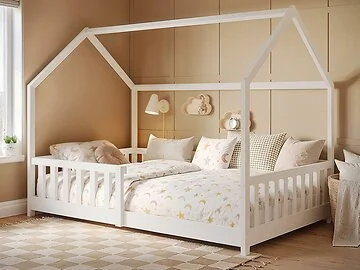 Flair FurnishingsFlair Explorer Playhouse Small Double Bed White
€439.99
Free delivery
 Flair FurnishingsFlair Logan Single Storage Low Sleeper Bed
€509.99
Free delivery
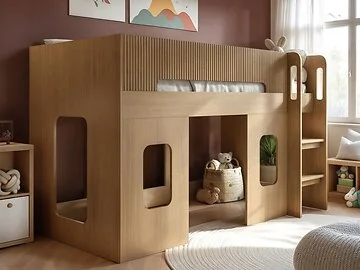 Flair FurnishingsFlair Lino Playhouse Mid Sleeper Bed
€499.99
Free delivery
 Flair FurnishingsFlair Nadia Single Montessori Floor Bed
€369.99
Free delivery
 Flair Furnishings Flair Wilbur Small Double Montessori Floor Bed with LED Lights
€449.99
Free delivery
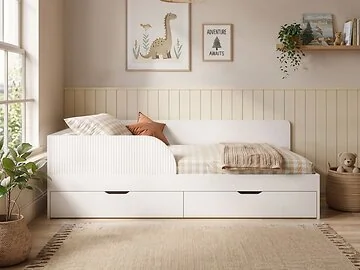 Flair FurnishingsFlair Aris Single Montessori Bed with 2 Storage Drawers
€399.99
Free delivery
Ages 6 to 9: cabin beds, mid sleepers and bunks
From 6, raised beds become an option, and this is when most families make the most of a small bedroom:
- Cabin beds add drawers and cupboards under the bed.
- Mid sleepers leave space underneath for play.
- Bunk beds let two children share, with the 6-and-over child on top.
See cabin, mid and high sleepers explained and the bunk bed safety guide.
Ages 10 to 12: high sleepers and desks
Homework starts to need a proper space. A high sleeper with a desk underneath gives you a bedroom and a study area in the floor space of one single bed, which is a big help in a box room. Read beds with desks.
Teenagers: a bigger bed and a place to hang out
Teenagers often outgrow a 3ft single, both in size and in style. A 4ft small double (120 × 190 cm) is a common next step if the room allows, and gaming beds, storage beds and grown-up upholstered designs all suit teenage rooms. See teenager and gaming beds.
How much sleep do children need?
The HSE's guidance on sleep gives these averages:
| Age group | Average sleep needed |
|---|---|
| Toddlers and babies | 12 to 17 hours |
| Children | 9 to 13 hours |
| Young people | 8 to 10 hours |
| Adults | 7 to 9 hours |
A comfortable bed in a dark, quiet, not-too-warm room helps. Our sleep tips summarise the HSE's advice.
Not sure? Use the finder
The kids' bed finder asks how many children share the room, their ages, your ceiling height and what matters most, then shows beds in stock today.
Common questions
What age should a child move from a cot to a bed?
There is no set age. Many children move when they start climbing out of the cot or when the cot is needed for a new baby. Choose a low toddler bed or floor bed for the first move.
What size bed should I buy for a 5-year-old?
A standard single (3ft, 90 x 190 cm) will last most children through primary school and into their teens. Keep it low until they are 6 if you are considering a raised bed.
When can a child have a high sleeper?
From 6. High sleepers and the upper bed of bunk beds must carry a warning, under EN 747, that they are not suitable for children under six.
What size bed is best for a teenager?
A single still works for many teenagers, but a 4ft small double (120 x 190 cm) gives more room if the bedroom allows it.
Keep reading
All guides & quizzes- Kids' bedsKids' bunk beds in Ireland: a parent's safety guideBuying a bunk bed in Ireland? What EN 747 means, the age 6 rule for the top bunk, mattress depth, guard rails, ceiling height and set-up tips.
- Kids' bedsCabin beds, mid sleepers & high sleepers explainedThe difference between cabin beds, mid sleepers and high sleepers, which ages suit each, ceiling height, mattresses and how to choose for an Irish box room.
- Kids' bedsBeds for shared kids' bedrooms: bunks, triples & trundlesTwo or three children sharing a bedroom? Compare bunk beds, triple bunks, L-shaped bunks and trundle beds by age, floor space and ceiling height.
- Kids' bedsMattresses for kids' beds & bunk bedsHow to choose a mattress for a child's bed, bunk bed or high sleeper: the maximum thickness rule, sizes in cm, small single and shorty, and feel.
- Kids' bedsBeds with desks: a study-ready kids' bedroomHigh sleepers and cabin beds with built-in desks: who they suit, ceiling height, lighting, posture tips and setting up a homework space in a small room.
- Kids' bedsToddler beds & Montessori floor bedsMoving your toddler from a cot: toddler beds vs Montessori floor beds, mattress sizes, guard rails, room safety and making the move go smoothly.
Free delivery on orders of €250 or more to the Republic of Ireland.