
Guide · Kids' beds
Kids' bunk beds in Ireland: a parent's safety guide
A bunk bed is the simplest way to fit two children into one bedroom, and a well-made one is very safe when it's used properly. This guide covers what the European bunk bed standard actually requires, which child should sleep on top, how thick the mattress can be and how to set the bed up in the room.
EN 747: the bunk bed safety standard
The European safety standard for bunk beds and high beds, used in Ireland, is EN 747 ("Furniture – Bunk beds and high beds"). Part 1 sets the safety, strength and durability requirements and Part 2 the test methods. The current edition is EN 747-1:2024, which replaced the 2012 version; you may still see beds labelled to EN 747-1:2012+A1:2015.
The standard applies to bunk beds and high beds whose upper bed base is 600 mm or more above the floor. Among other things it covers:
- Safety barriers on all sides of the upper bed. Under the EN 747-1:2012+A1:2015 edition, the top of the barrier had to be at least 260 mm above the bed base and at least 160 mm above the top of the mattress; the bed's instructions give the figures it was tested to.
- A marked maximum mattress thickness. Every bed must be permanently marked with the thickest mattress you can safely use, by a line, label or text. This is what keeps the barrier high enough above the mattress.
- The entry gap in the barrier (where the ladder or stairs arrive), which had to be 300 mm to 400 mm wide under the EN 747-1:2012+A1:2015 edition.
- Gaps and openings sized so a child's head, fingers or limbs can't get trapped, plus stability, ladder strength and the fixings between the two beds.
- Warnings: the bed must say that the upper bed (or a high bed) is not suitable for children under six.
When you're comparing bunk beds, look for EN 747 in the product description or the assembly instructions. If it isn't mentioned, ask the seller before you buy. Contact us if you'd like us to check a specific bed.
Who sleeps on top? The age 6 rule
EN 747 requires bunk beds to carry the warning that the upper bed is not suitable for children under six years, because of the risk of injury from falls. That gives you a simple rule:
- The top bunk is for children aged 6 and over.
- A younger brother or sister can sleep on the bottom bunk.
- For two children under 6, choose a bed with a pull-out trundle or two low single beds instead, and move to a bunk later.
Not sure which bed suits your family? Our kids' bed finder asks about ages and room size and never suggests a raised bed for a child under 6.
Bunk beds in stock for Ireland
View all (79) Flair FurnishingsFlair Eddie Staircase Triple Bunk Bed with Storage
From €839.99
Free delivery
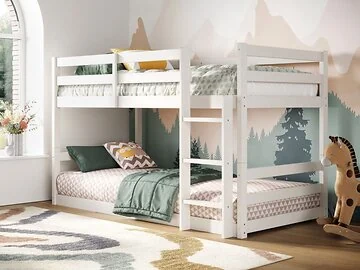 Flair FurnishingsFlair Shasha Low Wooden Detachable Bunk Bed
€369.99
Free delivery
 NoomiNoomi Nora Solid Wood Bunk Bed (FSC-Certified)
€449.99
Free delivery
 Flair FurnishingsFlair Shasha Low Shorty Wooden Detachable Bunk Bed
€359.99
Free delivery
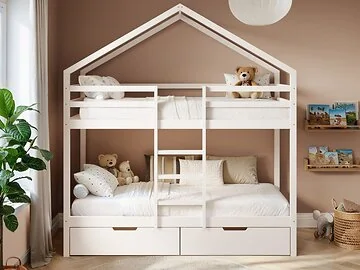 Save €30Flair FurnishingsFlair Nest House Bunk Bed with Optional Storage
From €399.99
€429.99Free delivery
 Flair FurnishingsFlair Tetrad Detachable Small Double Bunk Bed
€539.99
Free delivery
 Flair FurnishingsFlair Ollie Wooden Triple Bunk Bed with Storage Drawers
€659.99
Free delivery
 Flair FurnishingsFlair Eddie Storage Bunk Bed with Shelves
€589.99
Free delivery
Mattress depth and the guard rail
A common bunk bed mistake is a mattress that's too thick for the top bunk. A deeper mattress raises the sleeping surface and eats into the height of the safety barrier, so a child can roll over it more easily.
- Find the maximum mattress thickness marked on the bed or stated in its instructions.
- Choose a top-bunk mattress no thicker than that figure. Always go by your own bed, not a general rule.
- Use the size the bed is designed for (for example 90 × 190 cm for a standard single bunk). A mattress that's too small leaves a gap at the sides or ends.
The bottom bunk usually has more freedom, but check the instructions for that too. Our guide to mattresses for bunk beds covers depth, sizes and feel, and the mattress quiz can filter by the depth marked on your bed.
Measuring the room: ceiling, walls and windows
Before you order, measure three things:
- Ceiling height. Compare it with the bed's overall height on the product page. A child on the top bunk should be able to sit up without hitting their head, and remember light fittings.
- Floor space. Add room for the ladder or staircase. Staircase bunks are easier to climb and often have storage in the steps, but they need more floor.
- Where it will stand. Keep the top bunk away from windows, blind cords and ceiling lights or fans.
The instruction warnings in EN 747-1:2012+A1:2015 also say that the gap between the top barrier and an adjoining wall, sloping ceiling or piece of furniture should be either no more than 75 mm or more than 230 mm, so a child can't get trapped in it. Pushing the bed tight against the wall usually solves this.
Types of bunk bed
| Type | Good for | Think about |
|---|---|---|
| Standard bunk (ladder) | Two children, smallest footprint | Ladder climbing; the top child should be 6+ |
| Bunk with stairs | Younger climbers, extra storage in the steps | Needs more floor length |
| Triple bunk | Three children in one room | Two raised beds, so two children aged 6+; taller, check your ceiling |
| Bunk with trundle | Sleepovers, or a third child under 6 | Floor space in front for the trundle to pull out |
| Detachable bunk | Splitting into two single beds later | Check that the separated beds are sold as suitable singles |
| Small double / L-shaped | Older children, or an adult below | Wider footprint |
Assembly and everyday safety
- Assemble exactly as the instructions say and keep them. Check and re-tighten the fixings regularly, as bunk bed instructions advise.
- Fit all the guard rails, even on the side against the wall.
- Never hang belts, ropes, dressing gown cords, bags or toys from the bed. EN 747 instructions warn of a serious strangulation risk.
- No jumping or rough play on the top bunk, and only one child on top at a time.
- A night light helps younger children use the ladder safely at night.
- Secure tall furniture such as wardrobes and drawers to the wall too. The CCPC's furniture safety advice explains how to prevent tip-overs.
Delivery and assembly in Ireland
We deliver to addresses in the Republic of Ireland. Bunk beds arrive for home assembly, which isn't included in the price, and the boxes are big and heavy, so plan for two adults to carry and build it. See furniture delivery to Ireland for costs, timings and what the crew will and won't do.
- Delivery costFree on orders of €250 or more. Orders under €250: €50.
- Delivery timeDelivery in 10–14 working days. We’ll contact you to arrange a day.
- Returns14-day right to cancel (return costs and conditions apply)
- Ways to payCard, PayPal, Apple Pay, Google Pay, Klarna, Pay by Bank
Common questions
What age can a child sleep on the top bunk?
From 6 years old. The bunk bed standard EN 747 requires bunk beds to carry a warning that the upper bed is not suitable for children under six because of the risk of injury from falls.
Can a 4-year-old sleep on the bottom bunk?
Yes, the age warning in EN 747 is about the upper bed. Many families put a younger child on the bottom bunk and an older child (6 or over) on top. Check the product page for any age guidance specific to that bed.
How thick can a top bunk mattress be?
No thicker than the maximum mattress thickness marked on the bed. EN 747 requires that figure to be permanently marked so that the safety barrier stays high enough above the mattress.
Do bunk beds sold in Ireland have to meet EN 747?
EN 747 is the European standard that bunk beds and high beds are tested against to show they are safe, and it is the benchmark across the EU and the UK. Look for it in the product description or instructions, and ask the seller if it is not stated.
Can I use any single mattress on a bunk bed?
Use the size the bed is designed for, often 90 x 190 cm, and for the top bunk one that is no thicker than the maximum marked on the bed. A thick sprung mattress made for a divan is often too deep for a top bunk.
Keep reading
All guides & quizzes- Kids' bedsCabin beds, mid sleepers & high sleepers explainedThe difference between cabin beds, mid sleepers and high sleepers, which ages suit each, ceiling height, mattresses and how to choose for an Irish box room.
- Kids' bedsKids' beds by age: from first big bed to teen roomWhich bed suits your child at each age: toddler and floor beds, first single beds, cabin beds and bunks from 6, then high sleepers and teen beds.
- Kids' bedsBeds for shared kids' bedrooms: bunks, triples & trundlesTwo or three children sharing a bedroom? Compare bunk beds, triple bunks, L-shaped bunks and trundle beds by age, floor space and ceiling height.
- Kids' bedsMattresses for kids' beds & bunk bedsHow to choose a mattress for a child's bed, bunk bed or high sleeper: the maximum thickness rule, sizes in cm, small single and shorty, and feel.
- Kids' bedsBeds with desks: a study-ready kids' bedroomHigh sleepers and cabin beds with built-in desks: who they suit, ceiling height, lighting, posture tips and setting up a homework space in a small room.
- Kids' bedsToddler beds & Montessori floor bedsMoving your toddler from a cot: toddler beds vs Montessori floor beds, mattress sizes, guard rails, room safety and making the move go smoothly.
Free delivery on orders of €250 or more to the Republic of Ireland.