
Guide · Kids' beds
Cabin beds, mid sleepers & high sleepers explained
Raised kids' beds free up floor space in a small bedroom, but the names can be confusing. Here's what each type is, which ages it suits and what to check before you buy.
What's the difference?
| Type | What it is | Under the bed | Typical age |
|---|---|---|---|
| Cabin bed | A single bed raised a little off the floor on a storage base | Drawers, cupboards, shelves, sometimes a pull-out desk | Depends on the height: check the product page |
| Mid sleeper | Raised to about mid height with a short ladder or steps | Open space for play, a den, or storage | Usually 6+ (see below) |
| High sleeper | Raised high enough for a desk or seating underneath | Desk, wardrobe, futon chair or a chill-out space | 6+, often bought for older children and teens |
| Low sleeper | Only slightly raised, easy to climb into | Small storage or a play curtain | Younger children (check the product) |
Retailers use these names a little differently, so always look at the actual measurements on the product page: the height of the mattress base from the floor, and the bed's overall height.
The 600 mm line and the age 6 rule
The European standard for bunk beds and high beds, EN 747, covers any bed whose base is 600 mm or more above the floor. Beds in that group must have safety barriers on all sides, a marked maximum mattress thickness, and a warning that they're not suitable for children under 6. In practice that includes most mid sleepers and all high sleepers.
Rule of thumb: if the mattress base is 60 cm or more off the floor, treat the bed as suitable from age 6. For a younger child choose a low bed, a toddler bed or a cabin bed with a low mattress height, and check the age guidance on the product page.
There's more on barriers, mattresses and set-up in our bunk bed safety guide; the same rules apply to high sleepers.
Cabin beds
View all (52) Flair FurnishingsFlair Logan Single Storage Low Sleeper Bed
€509.99
Free delivery
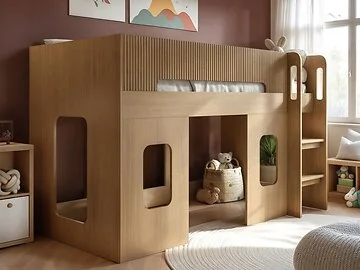 Flair FurnishingsFlair Lino Playhouse Mid Sleeper Bed
€499.99
Free delivery
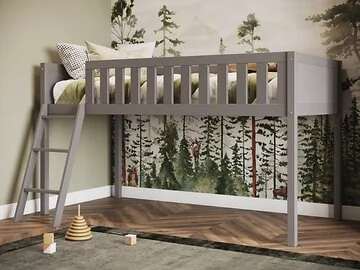 Save €40Flair FurnishingsFlair Bea Wooden Mid Sleeper
From €289.99
€329.99Free delivery
 Flair FurnishingsFlair Wooden Elara Shorty Mid Sleeper
From €319.99
Free delivery
 Save €40Flair FurnishingsFlair Elisa Velvet Storage Low Sleeper Bed with Beige Cord
From €409.99
€449.99Free delivery
 Flair Furnishings Flair Explorer Single Mid Sleeper House Bed with Safety Rails & Toy Box
 €429.99
Free delivery
 Flair FurnishingsFlair Aubrey Velvet Storage Low Sleeper Bed with Beige Cord
From €439.99
Free delivery
 Flair FurnishingsFlair Blair Low Sleeper Bed with Storage
€479.99
Free delivery
Which works best in a box room?
Box rooms are common in Irish semi-detached and terraced houses, and every centimetre counts. A raised bed puts the bed above the space you need for other things:
- Need storage? A cabin bed replaces a chest of drawers or a toy box.
- Need a homework space? A high sleeper with a built-in desk means you don't need a separate desk. See beds with desks.
- Need play space? A mid sleeper leaves room underneath for a den or a beanbag.
Measure the ceiling first. Your child needs to be able to sit up in bed on a high sleeper, so compare the bed's overall height with your ceiling height (and any light fitting). Our box room guide has more small-room ideas.
High sleepers
View all (47) Flair FurnishingsFlair Skyhigh Gaming High Sleeper Bed with Desk Anthracite
From €579.99
Free delivery
 Flair FurnishingsFlair Bea Wooden High Sleeper Bed
From €419.99
Free delivery
 RecoilRecoil Shuttle LED Gaming High Sleeper Bed Small Double Black
€867.99
Free delivery
 Save €110Flair FurnishingsFlair Wizard Junior High Sleeper Storage Station
€579.99
€689.99Free delivery
 Recoil GamingRecoil Summit Gaming High Sleeper with Wardrobe
From €609.99
Free delivery
 Save €80Flair FurnishingsFlair Wizard Junior Mid High Sleeper
From €429.99
€509.99Free delivery
 Recoil GamingRecoil Ultimate Vivid Gaming High Sleeper with Desk Charcoal & Green
From €589.99
Free delivery
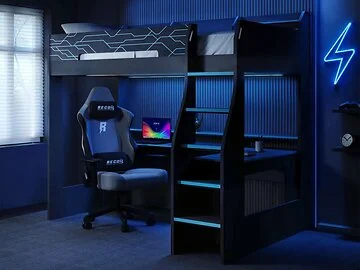 Recoil GamingRecoil Ultimate Neon Gaming High Sleeper with Desk Charcoal & Blue
From €589.99
Free delivery
Mattresses for raised beds
On any bed with a safety rail, use a mattress no thicker than the maximum marked on the bed, so the rail stays high enough above the sleeping surface. Most cabin beds, mid sleepers and high sleepers take a standard 3ft single (90 × 190 cm); some take a small single or another size, so check before you order. Read mattresses for kids' beds and bunks, or use the mattress quiz.
Shop by type
- Cabin beds (52)
- High sleepers (47)
- Mid & high sleepers (new in) (24)
- Kids storage beds (130)
- Gaming beds (32)
Or answer a few questions in the kids' bed finder.
Common questions
What is the difference between a mid sleeper and a high sleeper?
Both raise the bed off the floor. A mid sleeper sits at roughly mid height, leaving space underneath for play or storage; a high sleeper is tall enough to fit a desk or seating underneath. Exact heights vary, so check the measurements on the product page.
What age is a high sleeper suitable for?
High sleepers have a raised bed base, and EN 747 (the European standard for bunk beds and high beds) requires a warning that they are not suitable for children under 6. They are usually bought for children from about 6 up to teenagers.
Is a cabin bed the same as a mid sleeper?
Not quite. A cabin bed is a raised single on a storage base (drawers, cupboards or a desk), while a mid sleeper is usually open underneath. Some ranges use the names interchangeably, so go by the height and features listed on the product page.
Do I need a special mattress for a high sleeper?
You need the right size, usually a 90 x 190 cm single, and a mattress that is no thicker than the maximum thickness marked on the bed, so the safety rail stays high enough.
Keep reading
All guides & quizzes- Kids' bedsKids' bunk beds in Ireland: a parent's safety guideBuying a bunk bed in Ireland? What EN 747 means, the age 6 rule for the top bunk, mattress depth, guard rails, ceiling height and set-up tips.
- Kids' bedsKids' beds by age: from first big bed to teen roomWhich bed suits your child at each age: toddler and floor beds, first single beds, cabin beds and bunks from 6, then high sleepers and teen beds.
- Kids' bedsBeds for shared kids' bedrooms: bunks, triples & trundlesTwo or three children sharing a bedroom? Compare bunk beds, triple bunks, L-shaped bunks and trundle beds by age, floor space and ceiling height.
- Kids' bedsMattresses for kids' beds & bunk bedsHow to choose a mattress for a child's bed, bunk bed or high sleeper: the maximum thickness rule, sizes in cm, small single and shorty, and feel.
- Kids' bedsBeds with desks: a study-ready kids' bedroomHigh sleepers and cabin beds with built-in desks: who they suit, ceiling height, lighting, posture tips and setting up a homework space in a small room.
- Kids' bedsToddler beds & Montessori floor bedsMoving your toddler from a cot: toddler beds vs Montessori floor beds, mattress sizes, guard rails, room safety and making the move go smoothly.
Free delivery on orders of €250 or more to the Republic of Ireland.