
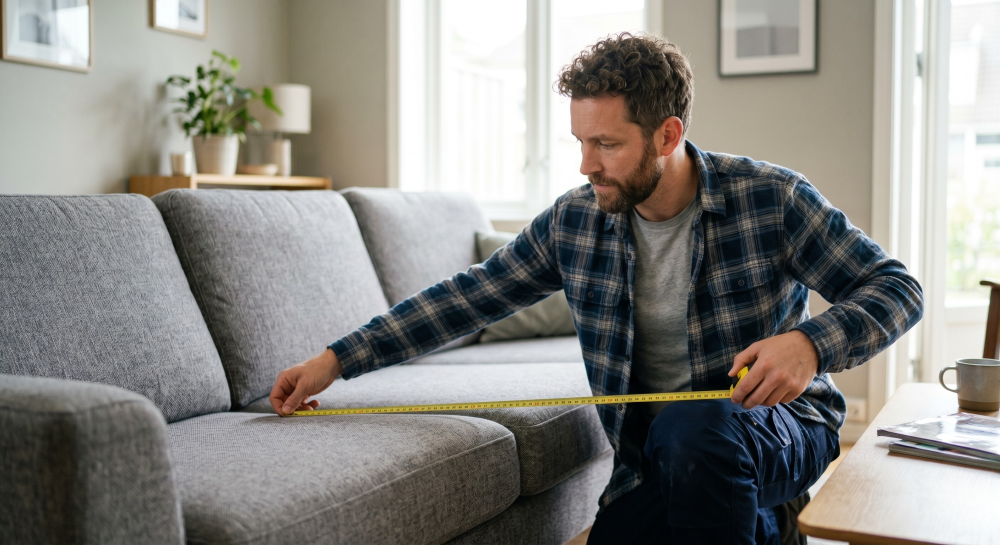
Start with the room itself rather than the sofa.
You'll need a tape measure, somewhere to record your measurements and, ideally, masking tape or newspaper so you can map out the sofa's footprint.
1. Measure the Length and Width of the Room
Measure your room from wall to wall and record its overall length and width.
This gives you the basic dimensions, but don't stop there. What really matters is how much usable space you have for the sofa.
Make a note of:
- Doors
- Windows
- Radiators
- Fireplaces
- Alcoves
- Built-in furniture
- Plug sockets
- Shelving
- Other furniture you're keeping
These can all affect where your sofa can comfortably sit.
2. Measure the Available Sofa Space
Decide roughly where you'd like your sofa to go and measure that specific area.
Check:
- Available width: The space from side to side
- Available depth: How far the sofa can project into the room
- Available height: Particularly important below windows or shelves
Don't choose a sofa simply because its width is smaller than the wall.
A deep sofa can take up far more of your living room than expected, so width and depth should always be considered together.
3. Check Doors, Windows and Radiators
Look at what surrounds the proposed sofa position.
Will a nearby door still open fully? Can you reach the window? Will the sofa sit directly in front of a radiator?
Also consider curtains, drawers and cupboard doors that need room to open.
It's easier to adjust the layout now than once a large sofa is sitting in the middle of the room.
4. Measure Your Existing Furniture
If you're keeping your coffee table, TV unit, armchairs or side tables, measure these too.
Your sofa isn't going into an empty room, so checking everything together gives you a much more realistic idea of the finished layout.
Consider:
- Coffee tables
- Side tables
- Armchairs
- Footstools
- TV units
- Cabinets
- Bookcases
You want enough space to use each piece comfortably rather than simply squeezing everything in.
5. Mark the Sofa Out on the Floor
This is one of the simplest and most useful sofa-measuring tricks.
Find the dimensions of the sofa you're considering and mark its full width and depth on the floor with masking tape.
Then walk around it.
Can you comfortably move through the room? Does it obstruct a doorway? Is there still enough room for your coffee table?
Seeing the sofa's actual footprint often tells you much more than looking at the measurements on a product page.
For a corner or chaise sofa, make sure you mark out the entire projecting section too.
How to Choose the Right Size Sofa for a Room
The right sofa size isn't simply the biggest one you can physically fit into the space.
A sofa should provide the seating you need while keeping the room comfortable and easy to use.
Think About How Many Seats You Actually Need
Start with your household.
If one or two people use the room most of the time, a large corner sofa might take up floor space you could use elsewhere.
For families or homes where you're regularly hosting guests, a larger three-seater, corner sofa or modular arrangement may make more sense.
Think about everyday use first rather than buying extra seating purely for occasional visitors.
Choose a Sofa That's in Proportion With the Room
A very large sofa can make a compact living room feel crowded, while a small sofa can look lost in a spacious open-plan area.
You don't need every centimetre of wall space to be occupied.
Leaving some breathing room around the sofa can make the furniture feel more considered and gives you flexibility for side tables, lamps and other pieces.
Consider Sofa Depth as Well as Width
Sofa width tends to get most of the attention, but depth can have an even bigger effect on a small room.
A deep sofa may provide generous lounging space but will also extend further into the room.
If floor space is limited, look at more compact sofa proportions rather than choosing purely by the number of seats.
For more ideas, read our guide to choosing the best sofas for small living rooms.
Check the Sofa's Height
Height affects both practical fit and how large the sofa feels visually.
A tall-backed sofa can provide plenty of support but may dominate a smaller room or block part of a low window.
Lower-backed designs can help maintain more open sightlines, particularly in compact or open-plan spaces.
Consider How Different Sofa Shapes Use Space
Different sofa types can use the same room very differently.
| Sofa type | Particularly useful for | Measurement to check carefully |
|---|---|---|
| 2 seater sofa | Small living rooms and flats | Overall width and depth |
| 3 seater sofa | Everyday family seating | Width and surrounding walkways |
| Corner sofa | Families and larger seating areas | Both sides of the corner |
| Chaise sofa | Lounging without a full corner sofa | Chaise projection |
| Modular sofa | Flexible and larger spaces | Complete configuration |
| Sofa bed | Guest rooms and multifunctional spaces | Full depth when opened |
If you're unsure which configuration will work best, see our guide to the different types of sofas before deciding.
Will My Sofa Fit Through My Hallway? A Step-by-Step Guide
Finding a sofa that fits beautifully in your living room is only part of the job.
It also has to reach it.
Walk from the entrance of your home to the sofa's final position and identify every point the delivery team will need to pass through.
Step 1: Measure the Front Door
Measure the usable:
- Door width
- Door height
Measure the actual open space rather than simply measuring the outer frame.
Door handles, frames and other fittings can reduce the available clearance.
Also check the space immediately inside and outside the doorway. A sofa may need to be tilted or turned as it's brought inside.
Step 2: Measure the Hallway
Measure the hallway at its narrowest point.
Don't assume the width stays the same throughout.
Look for anything that could reduce the available space, including:
- Radiators
- Console tables
- Skirting boards
- Light fittings
- Shelves
- Coat hooks
Where possible, movable furniture can be cleared before delivery.
Step 3: Check Tight Corners
Corners are often where access becomes difficult.
A hallway can be wide enough for the sofa but still not provide enough room to turn it.
Pay particular attention to 90-degree bends and the space immediately before and after them.
Step 4: Measure Internal Doorways
Your front door isn't necessarily your narrowest doorway.
Measure every internal door the sofa needs to pass through before reaching the living room.
Again, measure both width and height at the smallest usable point.
Step 5: Check Staircases
If the sofa needs to travel upstairs, measure:
- Stair width
- The narrowest section
- Ceiling clearance
- Bannisters and handrails
- Landings
- Turns at the top and bottom
A sofa may fit between the walls but still lack enough space to pivot around a landing.
Step 6: Measure the Lift if You Live in a Flat
For flats and apartments, check whether the sofa will travel in a lift.
Measure:
- Lift-door width
- Lift-door height
- Internal lift width
- Internal lift depth
- Internal lift height
Don't forget the hallway between the lift and your front door.
Step 7: Compare Everything With the Sofa Dimensions
Now compare your narrowest access measurements with the dimensions of the sofa.
Check whether the sofa arrives:
- Fully assembled
- In multiple sections
- With removable legs
- With removable backs
- As separate modular units
A large modular sofa may be easier to deliver than a smaller sofa supplied as one solid piece.
If you're unsure, check the individual product's delivery and assembly information before ordering.
Common Mistakes When Measuring for a Sofa
Measuring the Wall but Not the Floor Space
A sofa might fit perfectly along your wall while projecting too far into your living room.
Always check width and depth.
Forgetting the Hallway
Don't start and finish with the living room.
Measure the complete journey from your front door to the sofa's final position.
Ignoring the Chaise Section
With a chaise or corner sofa, that extra section can dramatically affect your usable floor space.
Measure the entire shape.
Forgetting Other Furniture
Your sofa needs to work alongside your coffee table, TV unit, storage and other seating.
Include everything you're keeping when planning your layout.
Not Checking How Doors Open
A sofa can technically fit beside a door but prevent it from opening properly.
Check the complete swing of nearby doors.
Trusting One Measurement
Measure important spaces twice before ordering.
That extra check can save considerably more work later.
Quick Tips for Measuring Your Room
- Measure in centimetres so it's easy to compare your figures with sofa specifications.
- Record each measurement rather than relying on memory.
- Check the sofa's width, height and depth.
- Measure your room at its narrowest points.
- Mark the sofa's entire footprint on the floor.
- Walk around the taped outline before ordering.
- Open nearby doors and cupboards to check clearance.
- Measure every part of the delivery route.
- Take particular care with corners, stairs and landings.
- Check corner-sofa and chaise orientation before buying.
- Measure sofa beds and recliners in their fully extended positions.
Find a Sofa That Fits Your Space
A good sofa fit comes down to more than whether it'll physically squeeze into the room. The right size should give you the seating you need while leaving your living space comfortable, balanced and easy to move around.
Measure the room, mark out the complete sofa footprint and check every part of the delivery route before placing your order.
Once your measurements are ready, explore the sofa collection at Bed Kingdom to find the size, shape and style that works for your home.