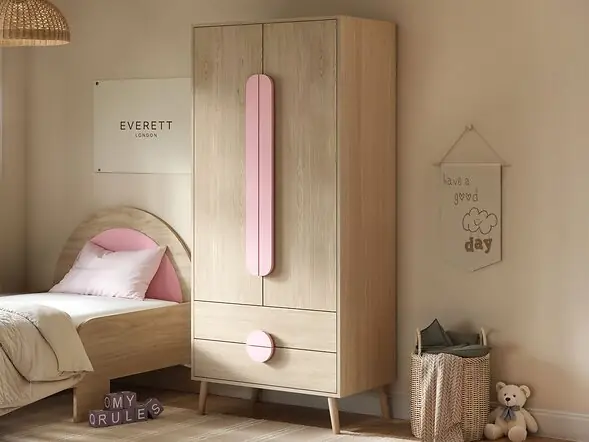
Bedroom wardrobes in sliding, mirrored, and wooden styles, available with drawers and in single, double, and triple-door configurations to suit any room size.
Whether you need a compact single wardrobe for a spare room or a triple-door unit to house a full wardrobe, there are several styles to choose from.
Sliding Door Wardrobes: The doors glide horizontally on a track rather than swinging open. Good for rooms where floor space in front of the wardrobe is limited, as no clearance is needed for the door swing. They suit modern bedrooms and tend to give a clean, built-in finish.
Mirrored Wardrobes: Feature a full-length mirror on one or more doors. Practical for getting dressed and useful in smaller rooms, as the mirror adds depth and reflects light.
Wardrobes with Drawers: Combine a hanging rail with integrated drawer storage. Useful if you want to reduce the need for a separate chest of drawers, keeping folded clothes and accessories in one unit.
2-door Wardrobes: A double wardrobe is one of the most versatile options and fits comfortably in most standard bedrooms. Most include a hanging rail, shelving, and internal storage.
3 and 4-door Wardrobes: Wider units suited to larger bedrooms. More doors mean more hanging space, additional shelving, and often a dedicated drawer section.
Corner Wardrobes: Designed to sit in the corner of a room and use space that would otherwise be wasted. Helpful in rooms with an awkward layout.
For children, take a look at our range of kids' wardrobes for more options. If you'd like to see any wardrobes in person before buying, visit our West Yorkshire showroom. Our team can walk you through the options and help you find the right fit.
Is it Better to Have a Wardrobe with Drawers or a Chest of Drawers?
It depends on your room layout and how you organise your clothes. A wardrobe with drawers combines two storage types into a single unit, saving floor space and working well in smaller bedrooms. A separate chest of drawers gives more flexibility in how you arrange the room and can be positioned wherever it fits best. In a larger bedroom, a matching wardrobe and chest of drawers from the same range create a coordinated look without any guesswork.
What Size Wardrobe Do I Need?
Measure the wall space before buying to know the size you need. Allow a minimum depth of 600mm for standard hanging, and ensure the doors can open fully without hitting a bed or other furniture. As a general guide:
Single wardrobes (approximately 75–90cm wide) suit smaller bedrooms, box rooms, and children's rooms.
Double wardrobes (approximately 100–120cm wide) work in most standard bedrooms and offer a mix of hanging and storage.
Triple and 4-door wardrobes (150cm+) are suited to larger bedrooms and give more dedicated space for folded items, shoes, and accessories.
How Deep is a Wardrobe?
Most standard wardrobes are between 55cm and 65cm deep. This is designed to fit a standard coat hanger (typically around 45–48cm wide) with a little clearance. Check individual product pages for exact dimensions, particularly if you're fitting a wardrobe into an alcove or a fixed space.
What Materials are Wardrobes Made from?
Material affects how a wardrobe looks, how long it lasts, and how easy it is to put together. Our range includes:
Wooden Wardrobes Made with MDF: A dense, smooth board that takes paint well and holds a consistent finish. Most painted wardrobes use MDF construction. Less prone to warping than solid wood in rooms with variable temperature or humidity.
Particle Board Wooden Wardrobes: A cost-effective board material, often finished with a wood-effect laminate. Widely used in flat-pack furniture, it offers a good balance of price and appearance for most bedrooms.
Oak Wardrobes and Wood Veneer: Solid oak wardrobes are built to last and bring real warmth to a room. Wood veneer achieves a similar look at a lower price point by applying a thin layer of real wood over a board core.
Metal Wardrobes: Used in specific styles, usually paired with fabric panels or in an industrial design. Lightweight and sturdy, though less common in a traditional bedroom setting.
What colour is best for a bedroom wardrobe?
Wardrobe colour has a significant impact on how a bedroom looks and feels, given the amount of wall space a wardrobe typically occupies. Here's how the main options work in practice:
White Wardrobes: Make a room feel brighter and more open. A reliable choice in smaller bedrooms and easy to pair with almost any wall colour or bedding. Timeless and hard to get wrong.
Cream Wardrobes: A warmer alternative to white. Cream sits well in traditional or country-style bedrooms and pairs naturally with warm wood tones, aged brass hardware, and earthy or neutral palettes.
Grey Wardrobes: A flexible neutral. Light grey suits minimal interiors. Darker charcoal grey reads as more dramatic and pairs well with white walls, natural wood accents, or soft blush tones.
Black Wardrobes: A bold choice that anchors a room. Best suited to larger bedrooms with good natural light. Pairs cleanly with white walls, brass or gold hardware, and pale flooring.
Natural Wood and Brown Wardrobes: Warm and grounding. Works well with off-white or warm neutral walls, linen textiles, and plants. Suits contemporary and traditional bedrooms depending on the style.
Beige Wardrobes: A soft, warm neutral that blends into most bedroom schemes without dominating. Works well with layered textures, natural materials, and warmer wood tones for a calm, understated look.
Blue Wardrobes: Deep navy or slate blue wardrobes work well as a statement piece in an otherwise neutral bedroom. Pairs naturally with warm wood tones and light-coloured bedding.
Green Wardrobes: Sage and olive greens are increasingly popular as bedroom statement colours. These work best in rooms with good natural light and pair well with natural materials, warm wood, and off-white or terracotta accents.
Pink Wardrobes: Softer and more understated than you might expect in the right finish. Dusty rose or muted blush tones work well in a relaxed, feminine bedroom and pair well with white, cream, or natural wood furniture nearby.
Multicoloured Wardrobes: Typically featuring two-tone finishes or contrasting panels. A practical way to introduce colour without committing to a single bold tone across the full unit. Most combinations pair a neutral base with a contrasting accent on handles or frame edges.
If you're mixing individual pieces, the simplest approach is to anchor the room around one main tone and use a second colour or material as an accent. For example, a white wardrobe and an oak bedside table work well together without needing to match exactly.
Where Should I Put a Wardrobe in a Bedroom?
The most practical position is against a solid wall that isn't broken up by a window or doorway, so the wardrobe sits flush and doesn't block light or movement. In most bedrooms, this is one of the side walls or the wall facing the bed. Avoid positions where the door will swing into the bed or block a light switch.
Do Wardrobes Come Pre-Assembled or Flat-Pack?
Within our collection, both options are available. Some of our wardrobes arrive pre-assembled, so no tools or setup time are needed, whereas most of them are self-assembled, supplied flat-pack with fixings and instructions included. Assembly details are listed on each product page.
Do You Offer Free Delivery on Wardrobes?
Yes. All wardrobes come with free delivery across most of England, Scotland, and Wales with no minimum spend. Delivery times vary by product from next day through to 10–14 working days depending on the item. Full details are shown on each product page.
For matching bedroom storage, see our bedside tables, and bedroom sets to complete the look. If you need any help, our FAQ page covers common questions, or you can contact us directly.
Shopping from the UK?
It looks like you're browsing from the United Kingdom. Orders can't be placed on our Irish site with a UK delivery address, switch to our UK site to shop and check out in GBP.